

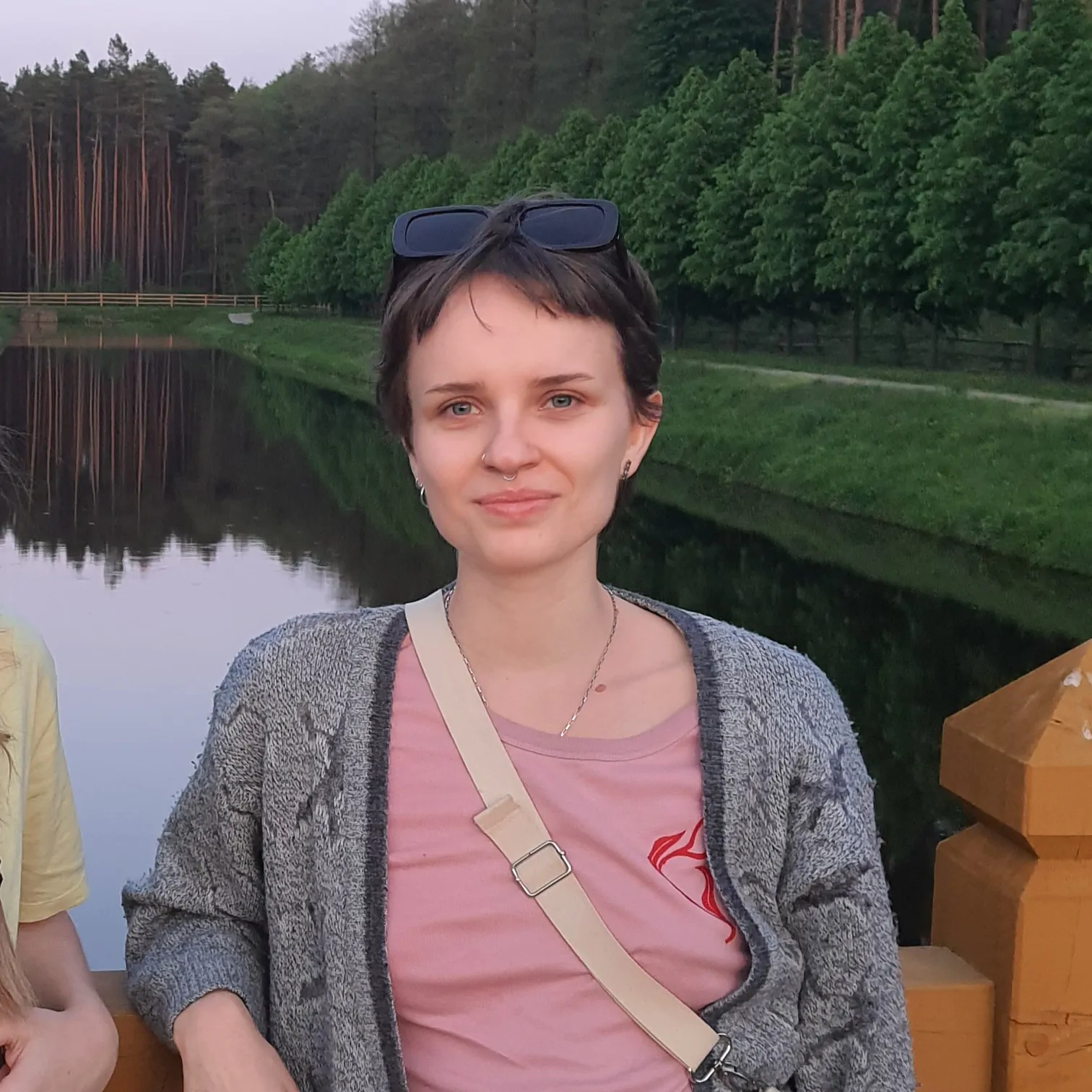
Katarzyna Tratkiewicz
Research interests
- Cellular basis for irradiation resistance in flatworms
- Microscopy techniques
- Taxonomy of catenulids
Ongoing research projects
- Elucidating ecological and developmental causes of asexual reproduction and colony formation in flatworms (Polish Returns NAWA, no. BPN/PPO/2023/1/00002), principal investigator: dr Ludwik Gąsiorowski
- Evolutionary perspective on irradiation resistance of stem cells (NCN Sonata 20, no. 2024/55/D/NZ3/00555), principal investigator: dr Ludwik Gąsiorowski
Publications
Majdi, Nabil; Dawson, Will; Evans, Isobel M.; Thurston, Louise; Gajda, Matylda; Lenti, Andrea; Smit, Harry; Fontaneto, Diego; Kamburska, Lyudmila; Dmuchowska, Wiktoria; Traunspurger, Walter; Carvajal, Mateo; Erseus, Christer; Shepherd, Matthew; Kieneke, Alexander; Garraffoni, André R. S.; Morek, Witold; Shilland, Ewan; Tihelka, Erik; Broz, Vojtěch; Brodecki, Jaroslaw; Vedovatti, Giovane; Bibby, Clay; Tratkiewicz, Katarzyna; King, Hannah; Keene, Dylan; Wilkinson, David; Huys, Rony; Horne, David; Budroe, Hannah; Notman, Gill; Esteban, Genoveva; Damme, Kay Van; Arya, Srishti; Laumer, Christopher
Results of a survey workshop on freshwater and limno-terrestrial meiofauna of the Lake District, UK Journal Article
In: Biogeographia – The Journal of Integrative Biogeography, vol. 41, no. 2, 2026, ISSN: 2475-5257.
@article{Majdi2026,

title = {Results of a survey workshop on freshwater and limno-terrestrial meiofauna of the Lake District, UK},

author = {Nabil Majdi and Will Dawson and Isobel M. Evans and Louise Thurston and Matylda Gajda and Andrea Lenti and Harry Smit and Diego Fontaneto and Lyudmila Kamburska and Wiktoria Dmuchowska and Walter Traunspurger and Mateo Carvajal and Christer Erseus and Matthew Shepherd and Alexander Kieneke and André R.S. Garraffoni and Witold Morek and Ewan Shilland and Erik Tihelka and Vojtěch Broz and Jaroslaw Brodecki and Giovane Vedovatti and Clay Bibby and Katarzyna Tratkiewicz and Hannah King and Dylan Keene and David Wilkinson and Rony Huys and David Horne and Hannah Budroe and Gill Notman and Genoveva Esteban and Kay Van Damme and Srishti Arya and Christopher Laumer},

doi = {10.21426/b6.63901},

issn = {2475-5257},

year  = {2026},

date = {2026-06-10},

urldate = {2026-06-10},

journal = {Biogeographia – The Journal of Integrative Biogeography},

volume = {41},

number = {2},

publisher = {California Digital Library (CDL)},

abstract = {The microscopic meiofauna dwelling freshwater and limnoterrestrial habitats remain poorly documented, despite representing an important, yet unseen, part of those ecosystems. Here, we report the results of a faunistic survey workshop intended to improve our knowledge of meiofauna diversity and distribution in a protected area: the Lake District National Park, UK. The survey workshop provided 299 occurrence records of 209 distinct morphological taxa of meiofauna belonging to 46 families, 24 orders and 11 phyla. These records are made publicly available through a shared online dataset. The highest number of taxa belonged to Arthropoda (58 taxa; i.e. 28% of records), followed by Rotifera (33; 16%), heterotrophic unicellular eukaryotes (30; 14%), Nematoda (26; 12%), Annelida (20; 10%), Tardigrada (19; 9%), Gastrotricha (12; 6%), and Platyhelminthes (11; 5%). Moss samples returned the highest number of taxa occurrences (136), followed by periphyton (54), epipsammon (34), interstitial (25), plankton (17), peat bogs (16), forest litter (7), soil (6), epizoic lifestyle on crustaceans (2), and lichen (2). By documenting a wide range of habitats and taxonomic groups, this survey workshop contributes to filling knowledge gaps on the distribution of meiofaunal taxa in nearly pristine freshwater and temperate rainforest ecosystems. The second role of the survey workshop was offering a 15-day field and laboratory training programme for a group of early career researchers, providing hands-on experience in morphotaxonomic identification, molecular barcoding techniques and finally in analysing and communicating the results in the form of the current publication.},

keywords = {},

pubstate = {published},

tppubtype = {article}

}
Tratkiewicz, Katarzyna; Baczyński, Jakub; Gąsiorowski, Ludwik
Molecular phylogeny of Catenulida (Platyhelminthes) with special focus on their diversity in Poland Journal Article
In: Zoological Journal of the Linnean Society, vol. 206, iss. 2, 2026, ISSN: 1096-3642.
@article{Tratkiewicz2026,

title = {Molecular phylogeny of Catenulida (Platyhelminthes) with special focus on their diversity in Poland},

author = {Katarzyna Tratkiewicz and Jakub Baczyński and Ludwik Gąsiorowski},

doi = {10.1093/zoolinnean/zlag003},

issn = {1096-3642},

year  = {2026},

date = {2026-02-03},

urldate = {2026-02-03},

journal = {Zoological Journal of the Linnean Society},

volume = {206},

issue = {2},

publisher = {Oxford University Press (OUP)},

abstract = {Catenulida is a clade of free-living flatworms found abundantly in freshwater habitats across the globe. Despite their ubiquitous distribution, catenulids remain poorly studied; most of the species are known only from the asexual forms that lack distinct, taxonomically useful characters. Accordingly, the studies of catenulid diversity require application of integrative methods that combine morphological and molecular data. Here, we report a survey of catenulid diversity in Central and Western Europe, with a special focus on the species found in Polish freshwaters. We collected and identified 13 distinct morphotypes that were subsequently sequenced for four molecular markers—18S, 28S, COI, and ITS-5.8S. The obtained sequences, together with reference data from other catenulid species, were used to infer the comprehensive phylogeny of the clade. This analysis confirms the previous results on deep nodes of catenulid phylogeny, and also revealed several well-supported clades within the largest catenulid family Stenostomidae, each distinguished by unique combinations of morphological features. Moreover, based on our molecular and morphological data, we recognize Stenostomum heebuktense, as a younger synonym of Stenostomum gigerium and Catenula confusa, as a younger synonym of Catenula lemnae. We also highlight the major challenges in catenulid taxonomy, particularly the unresolved species complexes of Stenostomum leucops and Stenostomum simplex.},

keywords = {},

pubstate = {published},

tppubtype = {article}

}
Tratkiewicz, Katarzyna; Gąsiorowski, Ludwik
Spontaneous ectopic head formation enables reversal of the body axis polarity in microscopic flatworms Journal Article
In: Proceedings of the Royal Society B: Biological Sciences, vol. 292, iss. 2057, no. 20251941, 2025, ISSN: 1471-2954.
@article{Tratkiewicz2025b,

title = {Spontaneous ectopic head formation enables reversal of the body axis polarity in microscopic flatworms},

author = {Katarzyna Tratkiewicz and Ludwik Gąsiorowski},

doi = {10.1098/rspb.2025.1941},

issn = {1471-2954},

year  = {2025},

date = {2025-10-00},

urldate = {2025-10-00},

journal = {Proceedings of the Royal Society B: Biological Sciences},

volume = {292},

number = {20251941},

issue = {2057},

publisher = {The Royal Society},

abstract = {In most of the animals, the antero-posterior axis is specified during early embryogenesis. However, in the organisms that undergo somatic asexual reproduction, constant re-establishment of the body axis occurs during each asexual act in the context of the fully formed adult body. In microscopic flatworms from the genus Stenostomum the new head and tail structures are inserted in the pre-existing body plan during the asexual process known as paratomy. Here, we report a spontaneously occurring developmental error that results in the formation of worms with double heads at opposite ends of their bodies, lacking posterior pole identity. In the set of experiments, we show that the double-head phenotype is not heritable on the organismal level. Worms originating from the sectioning or fission of the double-head animals give rise to the healthy populations that do not display the erroneous asexual development. We also demonstrate that the piece of the worm with ectopic head can survive, regenerate the tail on its previously anterior pole and resume asexual reproduction. Effectively, such regeneration allows stable reversal of the body axis polarity without impairment of the survival or reproductive abilities of the animal, an exceptionally rare phenomenon among bilaterians.},

keywords = {},

pubstate = {published},

tppubtype = {article}

}
Tratkiewicz, Katarzyna; Wójtowicz, Joanna; Bukat, Alicja; Kowalewska, Łucja
Ciało prolamellarne jako unikatowy model błon biologicznych: struktura, funkcja i perspektywy aplikacyjne Journal Article
In: Postępy Biochemii, 2025, ISSN: 0032-5422.
@article{Tratkiewicz2025,

title = {Ciało prolamellarne jako unikatowy model błon biologicznych: struktura, funkcja i perspektywy aplikacyjne},

author = {Katarzyna Tratkiewicz and Joanna Wójtowicz and Alicja Bukat and Łucja Kowalewska},

doi = {10.18388/pb.2021_601},

issn = {0032-5422},

year  = {2025},

date = {2025-05-16},

urldate = {2025-05-16},

journal = {Postępy Biochemii},

publisher = {Polskie Towarzystwo Biochemiczne (Polish Biochemical Society)},

abstract = {<jats:p>The prolamellar body (PLB) is a complex membrane structure found in plant etioplasts that exhibits a diamond-type cubic symmetry. The PLB features a unique architecture based on two independent aqueous channels of distinct geometries: the larger one remains in contact with the plastid stroma, while the smaller one serves as a precursor to the thylakoid lumen. This structure is formed through a precisely organized arrangement of lipids (mainly MGDG and DGDG), proteins (primarily LPOR), and pigments (including protochlorophyllide and carotenoids). Studies involving mutants with altered biochemical compositions, and analyses of stress factors affecting PLB organization, have clarified the roles of individual components in its formation and stabilization. The PLB’s unique features—such as its large scale (approximately 80 nm), phototransformation capability, and biocompatibility, make it a compelling model for new biomaterials, particularly in controlled-release systems. Recent advances in creating biomimetic structures inspired by the PLB have opened new avenues in nanomaterials engineering.</jats:p>},

keywords = {},

pubstate = {published},

tppubtype = {article}

}